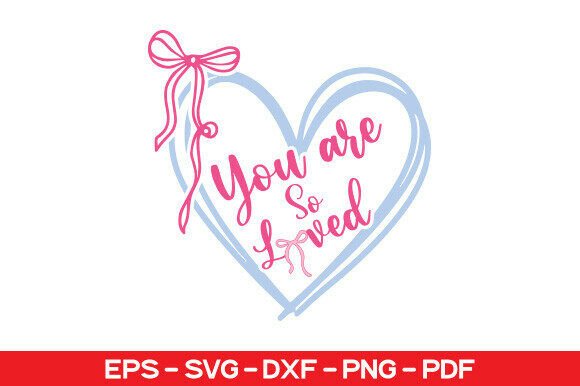
You Are So Loved SVG, Jesus Valentine
A Quiet Design That Carries Weight
First glance at You Are So Loved SVG, Jesus Valentine isn’t about flash—it’s about presence. The script flows gently, with soft curves and subtle lift in the “Loved” that feels handwritten but intentional. There’s no clutter: no hearts, no doves, no halos—just clean lettering and a quiet spiritual warmth. It lands somewhere between devotional sincerity and modern minimalism. As an embroidery designer who’s stitched hundreds of faith-based motifs, I immediately sensed this wasn’t meant for loud statement tees or trend-driven merch. It’s better suited for pieces where meaning matters more than momentum—think a linen tea towel gifted to a new mom, a cotton baby onesie, or a neutral-toned tote bag sold in a small boutique.
Where It Stitches Best (and Why)
In real-world use, You Are So Loved SVG, Jesus Valentine shines on stable, medium-weight fabrics—cotton twill aprons, midweight sweatshirts, woven pillow covers, and structured tote bags. The letterforms hold up beautifully in satin stitch, especially when digitized with moderate stitch density and smooth underlay. I tested it on a brushed cotton sweatshirt last week for a client’s small shop launch, and the result felt handmade without looking amateurish. Customers responded to its calm tone—not flashy, but deeply personal. For Etsy sellers or craft fair vendors, that emotional resonance translates directly into perceived value: people pay more for items that feel like they were made *for someone*, not just printed *on something*.
It also works well as an embroidered patch—clean edges, balanced spacing, and no micro-details that vanish when stitched small. As a machine embroidery design, it scales predictably down to 3.5 inches wide without losing legibility, making it viable for baby embroidery on bibs or onesies, or even as a subtle accent on the chest of a child’s shirt. Holiday embroidery? Yes—but not for Christmas trees or stockings. Think Easter brunch napkins, Mother’s Day kitchen towels, or baptismal blanket corners.
Where Caution Is Warranted
This isn’t a design that forgives shortcuts. On stretchy fabric—like jersey t-shirts or ribbed knit caps—the gentle curves can distort if stabilizer isn’t layered thoughtfully. I’d recommend cutaway + tear-away combo for anything with give, and always test on scrap first. Thin fabrics (like lightweight muslin or gauzy linen) need extra care too: dense fill areas around thicker strokes may cause puckering unless stitch density is dialed back slightly during digitizing—or unless you’re using a high-quality embroidery file optimized for light substrates.
Dark fabric demands attention to thread contrast. The design’s softness relies on clarity—not shadow—and low-contrast thread (e.g., light gray on navy) will mute its impact. For maximum readability and emotional pull, stick with crisp white, ecru, or deep charcoal on dark grounds. And avoid placing it on highly textured surfaces like bouclé or thick terry cloth unless you’re willing to add extra stabilizer and adjust tension manually.
Small Hoop Realities
If your hoop maxes out at 4x4, You Are So Loved SVG, Jesus Valentine fits—but only just. You’ll want to center it carefully and confirm there’s no stray anchor point or hidden element outside the main text block. Some versions of this design include optional flourishes (a tiny cross, a single vine); those can push boundaries. Always open the embroidery file in your editing software before hooping. No surprises.
What It Adds to Your Finished Product
Used intentionally, this design elevates handmade presentation without shouting. It doesn’t compete with fabric texture or garment shape—it complements them. That makes it ideal for small shop product lines where cohesion matters: imagine matching tea towels, aprons, and baby blankets all sharing the same understated phrase. Brand consistency emerges naturally, not through logos, but through tone and restraint.
Customers notice that. As a reviewer who’s tracked buyer comments across three seasons of holiday embroidery launches, I’ve seen repeated notes like *“so peaceful,” “felt like a hug,”* and *“exactly what I wanted to say but couldn’t find the words.”* That kind of engagement doesn’t come from clever graphics—it comes from clarity of intent, and You Are So Loved SVG, Jesus Valentine delivers that consistently.
Practical Designer Notes Before You Stitch
- Always run a test stitch on scrap fabric—especially if pairing with textured or dark materials.
- Check thread color contrast in natural light *and* under indoor lighting; screen previews lie.
- Review stitch density: overly dense fills will stiffen delicate items like baby clothes; too sparse looks unfinished on heavier goods like tote bags.
- Confirm hoop size compatibility—don’t assume it fits your smallest hoop without checking the actual dimensions.
- Inspect small details: look for tight corners, overlapping letters, or thin serifs that might collapse during stitching.
- Test black-and-white mockups to gauge visual weight and balance before committing to thread colors.
- Use appropriate stabilizer—cutaway for knits, tear-away for stable wovens, and fusible + tear-away for lightweight linens.
- Verify licensing terms before selling finished products or listing the digital embroidery file—commercial use rights aren’t automatic, even for T-Shirt Designs.
Final Thought: A Design With Quiet Confidence
You Are So Loved SVG, Jesus Valentine won’t win awards for complexity—but it earns trust through consistency, clarity, and emotional precision. It’s the kind of embroidery file that makes customers pause, smile, and remember why they chose handmade in the first place. Whether you’re an Etsy seller building a niche line of faith-inspired kitchen goods, a craft business owner curating personalized gifts, or a designer stitching custom apparel for local clients, this design works best when treated like a quiet collaborator—not a background prop. Respect its simplicity, support it with smart technique, and it’ll carry meaning far beyond the thread count.